Note to Ben
Why Astro, not WordPress.
Ben, sooner or later someone at the bar will ask why the room's site is not on WordPress like every other business in St. Louis Park. This is the answer I would give, in the order I would give it.
One. Google already ran this comparison. I did not have to.
Google measures real visits to real sites and grades them as Core Web Vitals. In that field data, 66 percent of Astro sites pass. 48 percent of WordPress sites do. Astro publishes the comparison itself, drawn from HTTP Archive and the Chrome UX Report, which means the numbers come from actual visitors on actual phones, not a lab demo someone tuned for a screenshot. A member checking availability from the range on one bar of LTE is exactly who that gap describes.
Two. This site sends almost no JavaScript. That is the default, not a diet.
Astro ships zero JavaScript unless a page asks for some. On the homepage, the only script a visitor downloads is the small verdict card that rotates through Jane, Marcus, Priya, and Danny. Every other pixel is plain HTML the browser can paint immediately. Compare that to the page builders most WordPress shops reach for, which commonly ship 300 to 800 kilobytes of JavaScript before the first word renders. Even the slide you see moving between pages here is not an animation library. It is the browser's own view transition API, and when a visitor has reduced motion turned on, it steps aside on its own. Nothing for me to code, nothing for you to toggle.
Three. The CMS is a folder of text files, not a plugin marketplace.
Joe writes a journal entry as a Markdown file. You edit the operators list in a small form. The site rebuilds. There is no plugin store, no theme lock-in, no premium tier waiting behind the next update. And because the content is plain text in a repository, it survives any future platform move intact. If I walk away from Astro in five years, the writing walks with me. WordPress content lives in a database, braided into whatever theme and plugins wrote it, and untangling that is a paid project.
Four. The reserve form does not need a WordPress login to defend.
When a member reserves a session, the form posts to a small Cloudflare Worker. The Worker writes the reservation down. You read it in the admin dashboard. There is no wp-login page for bots to hammer, no wp-admin, no plugin vulnerability to patch on Tuesdays. The marketing pages are static files, so there is no server behind them for anyone to break into.
Five. What the member sees is what the receipt says.
A member's data is only the verdict. Proto sits underneath, holding the encryption keys client-side. The site itself, the pages, the journal, the reserve form, none of it touches protected data. That separation is what keeps the Q4 2026 SOC 2 Type I scope small enough to finish. On a monolithic WordPress install, where the marketing pages and the member data share one database and one login, the scope covers everything.
Six. Same stack under the Proto wallet.
The room's site is one member-facing surface. The wallet surfaces are already live at the same address. globalproto.com is where a member finishes a wearable pull inside their own Proto wallet, and the room reads the verdict that comes back. Same static pages, same Cloudflare Worker for the receipt, same Proto wallet for the values themselves. If a member consents a new wearable tomorrow, it is a new scope in their wallet, not a new stack, a new plugin, or a new audit for the room.
Wearable data is where a bad pipeline hurts the most. Heart rate, sleep, load, recovery, every one of them is a stream that has to arrive intact and stay under the member's key. Static site plus Worker plus wallet is the only shape I trust to move that volume without leaking. A WordPress install with three body-data plugins is not a stack, it is a lawsuit waiting on the next database breach.
Seven. A member can permission their data to Aureum. Aureum never holds a copy.
Your biomarker data stays in your Proto wallet. When you join Aureum, you issue a permission that lets Aureum's room system read the verdicts it needs, for as long as you are a member. You can revoke it in one tap. Aureum keeps the reservation records and session notes that sit underneath the room. Aureum never holds a copy of your labs. The wallet is the source of truth. The room is a reader with a time-boxed grant.
This is what "encrypted wallet for your biology" means in one member's day. A guest walks in, taps to permission Aureum for the session, gets their verdict, walks out. The wallet stays with the guest. Aureum's audit scope stays small because Aureum is not storing labs, only reading verdicts under a scoped grant. That is the difference between infrastructure and a database.
Receipts
Five demos, measured on this page, this visit. Refresh to see them run again.
Google’s own test, side by side
Same tool, same day, run by Google. Aureum Haus on the left. A well-known brand studio on the right.
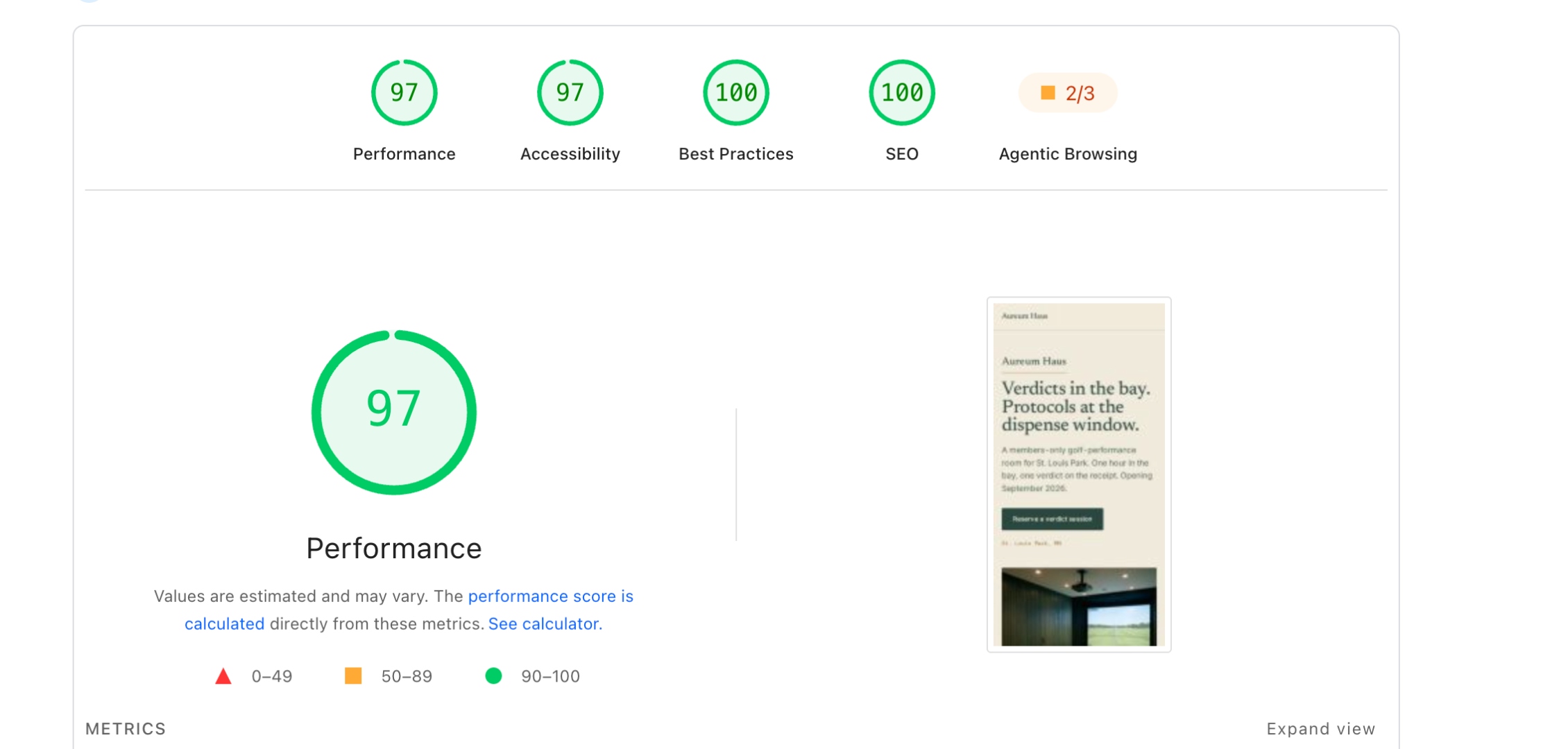
Perf 97 · A11y 97 · Best 100 · SEO 100
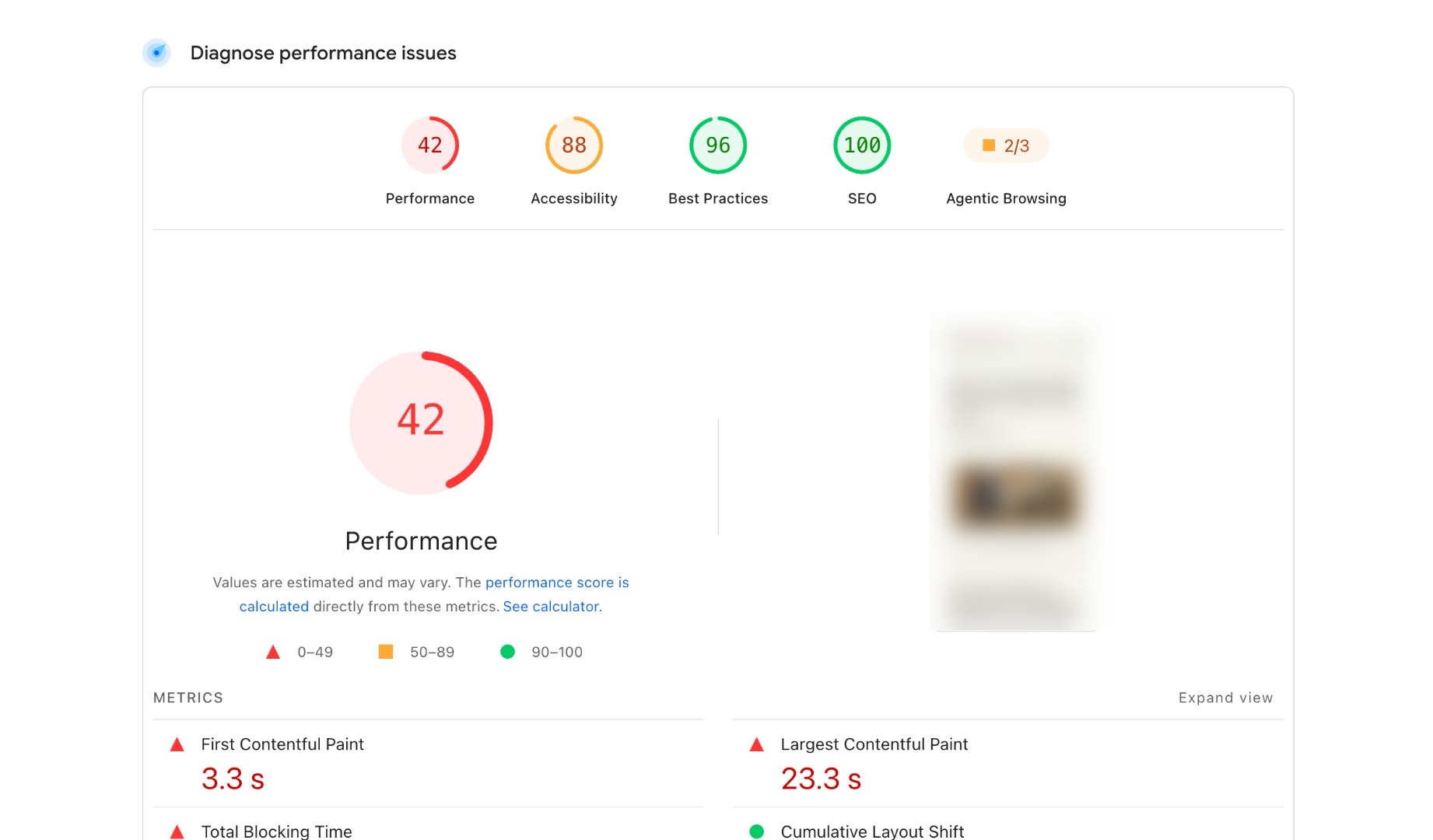
Perf 42 · A11y 88 · Best 96 · SEO 100 · LCP 23.3s
The right one is a real, live agency site built the way most creative shops build. Largest Contentful Paint of 23.3 seconds is roughly ten times Google’s good threshold. That is what a slow site actually costs, on Google’s scoreboard.
Run it yourself: pagespeed.web.dev on Aureum Haus.
This page, measured live
Core Web Vitals as they happen on your device, not from a lab. Google's threshold in parentheses.
Google's field data: 66 percent of Astro sites pass Core Web Vitals. 48 percent of WordPress sites pass.
JavaScript on this page, right now
Counted from the Resource Timing API. Not from a build report.
counting scripts
The verdict card, rotating
The one script on the homepage. About one kilobyte after gzip. Rotates every four seconds. Respects reduced-motion.
Page transitions, native
The browser owns the animation. Tap the panel to swap. Zero kilobytes of animation library. Turns itself off when reduced-motion is on.
tap the panel
Why the site never touches protected data
The room's site is static. The member's data lives client-side under Proto's keys. That separation is what keeps the SOC 2 scope small.
SOC 2 Type I, Q4 2026. Scope covers Proto only. The site sits outside the boundary.